
/source: wikipedia/
The Alaskan Malamute is a large northern dog breed originally bred for use as an Alaskan sleddog and are often mistaken as Siberian Husky.
Appearance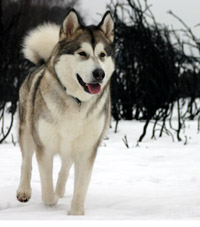
The AKC (American Kennel Club) breed standard calls for a natural range
of size, with a desired freighting weight of 75 to 85 pounds (34–38.5
kg) and a height of 23 to 25 inches (58–63.5 cm). Heavier individuals
(100+ pounds) and dogs smaller than 75 pounds are common—there is often a
marked size difference between males and females. Weights upwards of
140 pounds or more are occasionally seen; these dogs are uncommon and
are produced primarily by breeders who market a “giant” malamute. These
“giant” sizes are not in accordance with the breed’s history or the AKC
standard. The coat is a dense double northern dog coat, somewhat harsher
than that of the Siberian Husky. The usual colors are various shades of
grey and white, sable and white, black and white, red and white, or
pure white. Eyes are almond-shaped and brown; blue eyes are sometimes
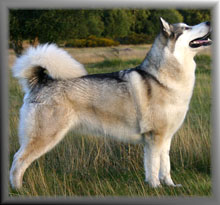
found, but will disqualify the dog in shows. The physical build of the
Malamute is compact with heavy boning. In this context ‘compact’ means
that their height to length ratio is fairly even, unlike dogs like Great
Danes which are longer and lankier in their ratios. One of the more
serious faults in malamutes is the tail carriage, you should be able to
fit your hand through the circle created by the tails curl, it should
not lie flat against the body of the dog or hang down one side.
Characteristics
 While
a few Malamutes are still in use as sled dogs for personal travel,
hauling freight, or helping move heavy objects, some are used for the
rapidly disappearing recreational pursuit of sledding mushing. However,
most Malamutes today are kept as family pets or show dogs. They are
unable to compete successfully in long-distance dogsled racing against
smaller and faster breeds, and their working usefulness is limited to
freighting or traveling over long distances at a far slower rate than
that required for racing. They can also help move heavy objects over
shorter distances. Their heavy bone and muscle structure put them in an
entirely different class than the lighter boned racing dogs, such as a
Husky. By definition the common Husky is a mixture of several different
breeds, and it would be difficult indeed to find a Husky which did not
have the endurance of a Malamute bred into its line somewhere in the not
too distant past.
While
a few Malamutes are still in use as sled dogs for personal travel,
hauling freight, or helping move heavy objects, some are used for the
rapidly disappearing recreational pursuit of sledding mushing. However,
most Malamutes today are kept as family pets or show dogs. They are
unable to compete successfully in long-distance dogsled racing against
smaller and faster breeds, and their working usefulness is limited to
freighting or traveling over long distances at a far slower rate than
that required for racing. They can also help move heavy objects over
shorter distances. Their heavy bone and muscle structure put them in an
entirely different class than the lighter boned racing dogs, such as a
Husky. By definition the common Husky is a mixture of several different
breeds, and it would be difficult indeed to find a Husky which did not
have the endurance of a Malamute bred into its line somewhere in the not
too distant past.
The Malamute is one of the most “unaltered” of breeds, retaining its original form and function. Responsible dog breeders will want to preserve this heritage of the Malamute’s working abilities. They are widely regarded as handsome, affectionate toward humans, particularly loyal to their family, very intelligent, extremely resourceful, and exceptionally hardworking. Their affectionate nature does not make them useful as watch or guard dogs. Their breeding was for an entirely different purpose, and expecting a Malamute to become a good guard dog goes against thousands of years of breeding.
The Malamute is also noted for independence of thought, and many a ‘musher’ has had their life saved by a Malamute refusing to obey a command because, for what ever reason, the dog can sense a danger of which the driver is completely unaware. Because this streak of independence is vital to survival in the wilderness it is difficult if not impossible to tame. A Malamute kept as a pet should never be off-lead in public.
The ability of this dog to think independently is often characterized as ‘stubborn’ by people who do not understand this breed, and this may prove very difficult and frustrating for a beginning dog owner. This is even more true if the owner is not aware of why this dog was bred to use its own senses and instincts and to ‘disobey’ its driver. A Malamute is completely aware of the sound and feel of the micro-cracking of ice packs while pulling loads across Arctic ice that may crack or break under the sled, or the sound of wilderness streams buried under snow which can have the snow collapse into them and swallow the team and driver, or the imperceptible sound and feel of one layer of snow moving over another that may lead to snow slippage or avalanche that could bury the team and driver, or the sound or smell of a bear around the next corner which could mean death to the team and the driver. All of these and more are the reason that a Malamute has been bred to think independently of the driver. And this is the exact reason a Malamute can never be thought of as ‘trained’. The Malamute will do what is best for the team and the driver, even if it means disobeying the driver. This is one reason that this bred is not for everyone who finds its beauty and smile irresistible.
If a dog owner cannot cope with a dog that will not comply with the owners every wish and command, no matter how beautiful, magnificent, or noble the dog looks, a more compliant breed should be selected. This independence of thought extends from its ability to survive and care for its driver in wilderness conditions, and living in modern cities for a tiny fraction of its genetic history should never tame this quality. And it hasn’t.
Because this dog has a long genetic foundation of living in the wilderness with man surrounded by other domesticated animals of approximately the same size, it should be watched very carefully around smaller dogs and animals and this is why it should never, ever, be off-lead in public or around smaller animals. The instincts of this breed are very strong and until another animal is accepted as part of its ‘family’ group, it is better to be safe than sorry.
This dog also needs a great deal of exercise to be happy. Any sled dog is never happier than when pulling a sled. This is as true of a Malamute as any other Sled dog. While a Malamute can feel absolutely at home in an apartment, a tent, or buried comfortably in the snow, it will never be happy unless it gets several very long walks a day, and most love a run of a mile or more every day. To a Malamute, a day without a run is a day without joy. This is a very old and primal breed of dog, and its needs are simple, but primal. Food, water, and a run. It’s simple, but often more than just anyone can give. It’s better to get a dog that fits your life style, than to get a dog that requires a life style you cannot provide.
While a Malamute is, as a strong rule, extremely gentle with people, and very loyal to every member of its human family, especially after it’s reached adulthood and settled down, until one knows the exact nature and disposition of a specific individual dog, it must always be watched around smaller animals, even those in the same household. Only time and experience will tell you when a specific dog can be left unwatched with other household pets. It is never safe to assume that because a given dog is comfortable with your other pets it will be comfortable with the other animals in the [[neighborhood or with pets of your friends in your house or in their house. One of the alluring traits of this breed is its strong instinctual sense and almost uncanny awareness of the world around it. But that very trait that is alluring, is also dangerous to smaller animals. Until one is completely familiar with a specific individual dog, never assume that you have ‘trained’ it. Because only a tiny fraction of the breeds life has been around modern man, it is still more of a working dog, bred to haul heavy freight long distances in harsh conditions, than a ‘show’ dog. Its relationship with its owner and its ‘family’ is deeply personal and devoted, but it is not a dog bred for large cities of thousands of people and thousands of other dogs.
A Malamute is generally a quiet dog and seldom barks like other dog breeds. When it does vocalize, more often than not they tend to “talk” by vocalizing a “woo woo” sound (the characteristic vocalizations of Chewbacca in the Star Wars films are based upon a Malamute named Indiana, once owned by George Lucas). They may howl like wolves or coyotes, and for the same reasons. When they howl, the howl is difficult, if not impossible, to distinguish from that most ancient ancestor of all dogs, the wolf. Anyone who has heard a Coyote yip, has heard a Malamute yip. Anyone who has heard a wolf howl, has heard a Malamute howl. This, too, is one of the alluring traits of this breed.
Temperament and behavior

Malamutes were originally bred to think and act independently for the sake of protecting the sled team and the driver. Hazardous and unpredictable Arctic trail conditions rewarded the ability of a Malamute to rely on its own senses and, when necessary, override the sled driver’s judgment and commands. As such, the breed is notorious for displaying a highly independent streak that manifests itself as stubbornness. Malamutes are sometimes downright insubordinate toward their human handlers and may ignore commands, particularly when young.
At the same time, Arctic life required that Malamutes be bred to behave as fully integrated members of the sled team, family, and the village community. Therefore they are usually very affectionate to members of their own pack – human and dog members alike. A Malamute may take glee in greeting a returning family or pack member after a period of separation, and howl in protest when it feels ignored, neglected, or excluded from group activities. This behavior should never be punished. Also, Malamutes are usually friendly to other humans outside their own pack, often demanding their attention and affection as well. This is part of being a functional part of an Arctic community. When a community is small, all members, human and dog, need to be on good terms with each other. This friendliness is a trait which has been bred into the Malamute.
The Malamute’s gregariousness and tendency to openly, unreservedly give affection make them highly attractive to many dog owners; these same qualities make a Malamute a poor guard dog. Not all big, fierce looking dogs are suitable for guarding. In a small Arctic village it would be difficult to find a need to protect your things from other people, so this trait was never important to select for. And there is good reason to select against it. When living in harsh arctic conditions the ability for the people of a village to get along with each other is more important than the need to protect yourself from the people who may one day be the ones who come to save your life.

The harsh conditions for which Malamutes were bred rewarded a strong prey drive, as food was often scarce. Consequently, Malamutes may instinctively attack animals such as smaller dogs, house cats, squirrels, rabbits, chickens, quail, and even deer (however, many households enjoy harmonious, mixed “packs” of cats and other animals living along side the Malamutes). Historic competition for food is also a reason why Malamutes may regard dogs outside their own pack or team with disdain or hostility. Some Malamutes have ‘food issues’.
This arises from a genetic history of food competition in the harsh arctic environment. Some dogs will become very protective of their food and may growl any anyone coming near them during feeding, including their owner. They may attack other dogs who come too close during feeding, and may take food from other animals. This behavior may be dampened if the dog was raised from a puppy and corrected early-on, but it may be just a stronger part of the primal makeup of one individual dog than another individual dog. The rule to not pet or bother a dog while it’s eating is elevated to a law with the Malamute.
Competition for food in an arctic environment lead to the survival of those dogs who competed best, this leaves it’s trace in the Malamute as a tendency to growl if you come too near when it’s eating. It also leaves the genetic tendency to attack other animals which come too near during eating. While this tendency generally remains at the growling level for dogs which have been raised together, or who have become accustomed to each other, there is always a ritual dog-fight simmering beneath the surface, and for this reason Malamutes should always be fed apart from each other and other animals.
Until you are absolutely certain of your individual dog and how they react to all the other animals in your house you should never break this rule. Even when you think you are aware and know your individual dogs ‘personality’, remember that it is not a ‘person’ and that the drive for food is a primal drive that lurks deep within the breed. If a fight erupts, it can be abrupt, startling, loud, and frighteningly violent, for this is a large and very powerful breed. Even in ritualistic dog fights among dogs who already know their place in the pack pecking order, animals (and people who get involved) can be seriously hurt. And household furniture can be broken.

Most Malamutes if raised in a home without other animals, or introduced into the home as a puppy will be fine if taught acceptable behavior when eating. If adopted into a house as a larger animal or when other animals are present, most will learn to feed without problem. But food issues with Malamutes are not uncommon, and this, too, is part of their primal behavior shaped by thousands of years of harsh Arctic life. With food, as with having the dog off-lead in public, it is better to be safe than sorry.
Malamutes dig for food when required, and digging is now a common way in which Malamutes deal with boredom. It is not uncommon to see a Malamute digging madly in pursuit of a mouse, mole, vole, or gopher. Malamutes may also dig to escape a fenced yard, and have been known to dig escape tunnels underneath houses. This tendency to dig can be particularly frustrating to owners who maintain yards or gardens. One way to prevent this boredom is to exercise the dogs every day. They have a genetic make up that makes them love to run. When you deprive a Malamute of the exercise they used to get by pulling sleds, you deprive that dog of a purpose in life, and it becomes bored, and will dig. Sometimes it will dig a hole in your bed, sofa, chair, or rug. If you notice that your dog is starting to dig on a regular basis, it is imperative that you take the dog for a walk or for a run and make this a regular part of your everyday routine.
They are extremely bright and perceptive animals, and need mental stimulation. Sometimes just a ride in a car will be enough, but remember that the Malamute was developed to run and to pull sleds and get a lot of exercise. Without stimulation, the dogs can become bored and frustrated. They will turn their attention to something that will give them exercise. Sometimes that is digging, and sometimes that digging is seen destructive by the dogs owner. If you find that you do not have the time to properly care for a Malamute, there are many other breeds of dogs from which to choose; and many of these breeds are happy at home, have many of the qualities of a Malamute, and do not require a lot of exercise or room to run.
Historically Malamutes would not only dig for prey, they would dig a shelter in the surface of the snow to escape the wind and just let the snowfall build up on top of them forming a blanket which would help trap their heat and keep them warm in the bitterly cold, windy climate. They will also dig a hole to cool off in warmer weather. Each layer of soil is cooler and a bit damper than the one on top of it, so a hole can become quite deep if the dog is not given ample shelter from the sun.
Owing to the Malamute’s independent nature, physical strength, and its high levels of energy and intelligence, most experts on the breed advise that Malamutes not be adopted by people who:
* are inexperienced in training dogs
* lack the time, energy, and space to exercise them, or
* lack the patience and stamina to repeatedly engage in contests of
willpower with a large, powerful animal without becoming angry.
Health

While Malamutes have been successfully raised in places such as Arizona, their dense coats generally make them unsuited for hot climates. When the weather gets hot, they—even more than other dogs—need plenty of water and shade. Also, being a winterised breed they will grow a winter coat and subsequently, come spring, shed it again.
History
The Malamute is a descendant of dogs of the Mahlemut tribe of upper western Alaska. These dogs stood prominently on equal footing with their human companions – working, hunting, and living alongside them. The interdependent relationship between the Mahlemut and their dogs fostered prosperity among both and enabled them to flourish in the inhospitable land above the Arctic Circle.
For a brief period during the Klondike Gold Rush of 1896, the Malamute and other sled dogs became extremely valuable to recently landed prospectors and settlers, and were frequently crossbred with imported breeds. This was often a misguided attempt to improve the type, or to make up for how few true Malamutes were up for sale. This genetic dilution seems to have had no long standing effect on the modern Malamute, and recent DNA analysis shows that Malamutes are one of the oldest breeds of dog, genetically distinct from other dog breeds.
The Malamute dog has had a distinguished history; aiding Admiral Richard Byrd to the South Pole, and the miners who came to Alaska during the Gold Rush of 1896. This dog was never destined to be a racing sled dog; instead, it was used for heavy freighting, pulling hundreds (maybe thousands) of pounds of supplies to villages and camps in groups of at least 4 dogs for heavy loads.